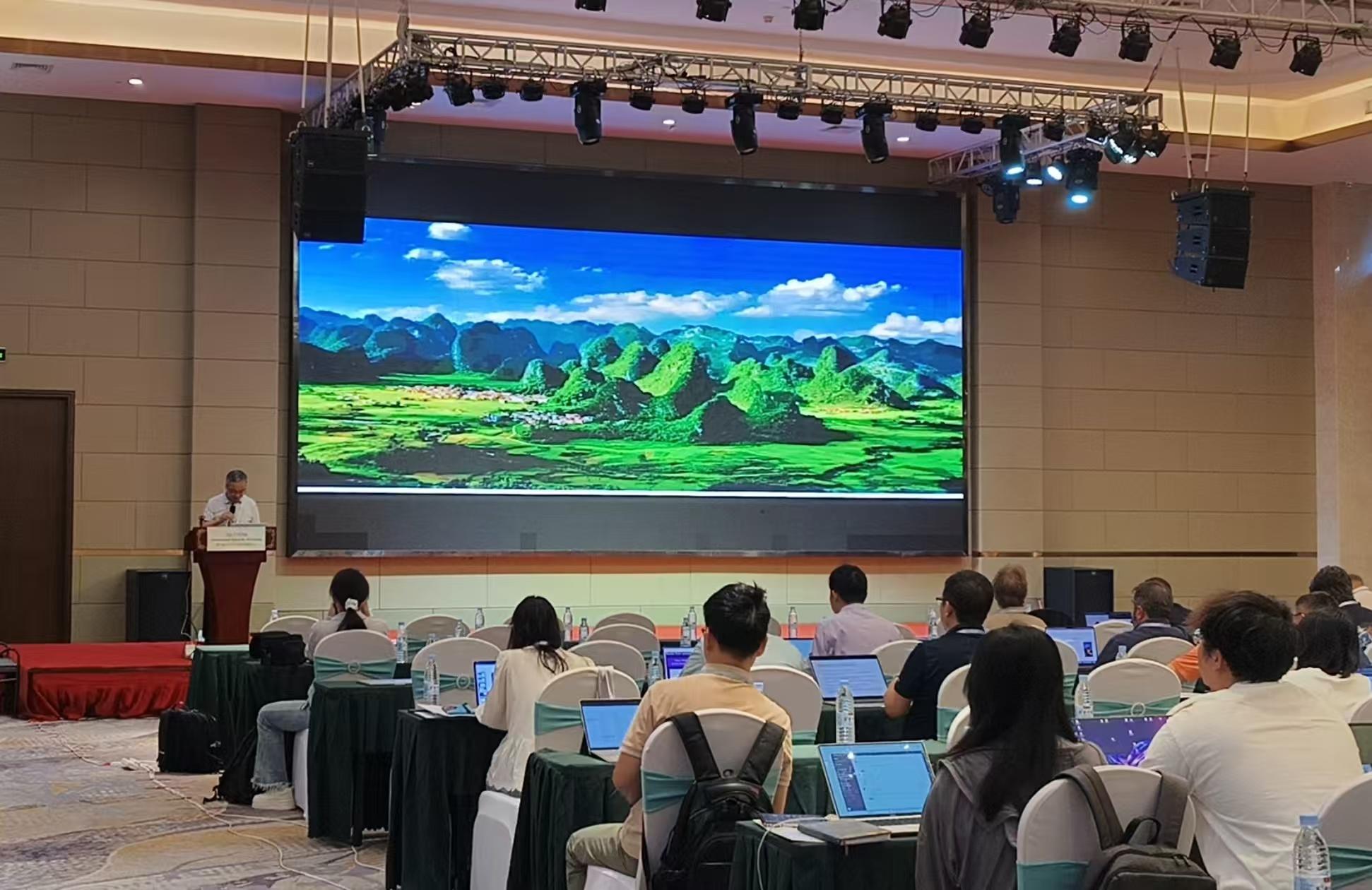
On October 17, the 7th SVOM Astronomical Satellite Science Symposium opened in Chongzuo, Guangxi. The symposium was hosted by the National Astronomical Observatories of the Chinese Academy of Sciences (NAOC) and co-organized by GXU, and was chaired by Wei Jianyuan, Chinese Chief Scientist of the SVOM astronomical satellite project. Bertrand Cordier, French Chief Scientist of the project, He Cheng, Director of the Division of Astronomical Sciences of the National Natural Science Foundation of China (NSFC), and Liang Enwei, Member of the Standing Committee of the CPC GXU Committee and Vice President of GXU, attended the opening ceremony and delivered speeches.
Wei Jianyuan welcomed the experts and scholars on behalf of the organizers and reviewed, on behalf of the Chinese team, the in-orbit progress of the SVOM satellite since its launch. He said that the satellite has successfully met all its scientific operating objectives and achieved a series of substantive results in gamma-ray burst detection.
Bertrand Cordier addressed the symposium on behalf of the French team and reviewed the course of China–France cooperation. He said that the Chinese and French SVOM mission teams have always worked in close coordination, expressed the expectation of further breakthroughs in scientific data analysis and research output, and wished the symposium fruitful exchanges.
He Cheng said that NSFC supports Chinese and foreign scientists in carrying out practical cooperation on the strength of major scientific facilities through programmes such as its science funds open to researchers worldwide, and encourages young scholars to take a deep part in international joint research. He expressed the hope that the two sides will give full play to the strengths of the SVOM platform, carry out research on key scientific questions concerning gamma-ray bursts and strive to produce a body of high-quality original results with international influence; deepen substantive cooperation, advance joint data analysis and academic exchanges, and build a long-term and stable joint research network, so as to make the SVOM astronomical satellite a benchmark of China–France astronomical cooperation; and attach importance to nurturing young talent and interdisciplinary innovation, jointly create more exchange opportunities for young researchers, and consolidate the talent pipeline in high-energy and space exploration.
Liang Enwei welcomed the experts and scholars on behalf of GXU. He noted that the SVOM astronomical satellite has been operating excellently since its launch and is a remarkable achievement of China–France space cooperation. He introduced the university’s foundation and investment in building up its astronomy discipline and its participation in the SVOM project, and said that GXU will continue to provide solid support for the scientific research and talent cultivation of the SVOM astronomical satellite project.
The symposium runs for a week, from October 13 to 19, and is held in two stages. The first stage focused on the satellite system and scientific preparations, with thorough discussions on system optimization and the organization of scientific assessment. The present opening marks the symposium’s move into the stage of thematic scientific discussion. After the opening ceremony, the symposium proceeded to academic presentations and exchanges. Dozens of invited talks are scheduled to showcase the latest research results of the Chinese and French sides in scientific fields related to the SVOM astronomical satellite and to present the research progress and cooperation outcomes of the two research teams in recent years. As an important vehicle for exchange in China–France space astronomy cooperation, the symposium not only provides a platform for in-depth communication between the two research communities but also lays a solid foundation for further cooperation between the two countries in time-domain astronomy.
SVOM stands for Space-based multi-band astronomical Variable Objects Monitor. It is an astronomical satellite jointly developed by China and France, implemented through cooperation between the China National Space Administration and the French National Centre for Space Studies (CNES), with the deep involvement of the Chinese Academy of Sciences and several French research institutions and the active participation of research teams from GXU and other Chinese universities. The satellite was launched from the Xichang Satellite Launch Center on June 22, 2024, carrying four scientific payloads – ECLAIRs, GRM, MXT and VT – and is capable of multi-band detection and rapid localization of gamma-ray bursts and other transient cosmic objects. As an important platform for time-domain astronomy and multi-messenger astronomy, SVOM takes multi-band observation of gamma-ray bursts as its core scientific objective while also supporting frontier topics such as the search for electromagnetic counterparts of gravitational-wave events and studies of the high-redshift universe and early stars. Since entering scientific operation, the satellite has successfully achieved its scientific operating objectives, detected more than 300 gamma-ray bursts in total, and set a new record for the most distant short-duration gamma-ray burst, providing important data support for research in related fields.
GXU is an important research force in high-energy astrophysics and time-domain astronomy in China. Relying on the Guangxi Key Laboratory for Relativistic Astrophysics, the university has taken part in the construction of ground-based observation facilities related to the SVOM astronomical satellite, set up observation stations and achieved scientific data sharing with partner groups. It has also built a research team with a complete echelon in gamma-ray bursts and other areas of high-energy astrophysics, and has trained a large number of academic and technical backbones for China’s deep space exploration, time-domain astronomy and high-energy astrophysics.
More than 150 experts and scholars from research institutions and universities in China and France attended the meeting.

 Home
>
News & Events
>
Events


